
Compliance you can prove. Access you control.
assetziq gives auditors, finance and security teams the same evidence: who can do what, who approved each change, and what happened to every asset.
- Transfer requestedRaised by the maker, with a reason
- ApprovedDecided by a second person
- Location updatedIn transit, then at site
- Register reconciledOutcome: matched
Four layers stand between a user and your asset record.
No single control is trusted on its own. A change has to pass every layer before it reaches the record, and each layer leaves evidence.
- Identity. Who you are, confirmed by single sign-on.
- Roles. What you may see and do.
- Approval. A second person decides on changes that matter.
- History. What happened, kept with the record.
A register and a lifecycle that stand up to audit.
Asset compliance comes down to four questions: does the asset exist, is the record complete, is the value right, and was each change authorized.
Audit-ready register
Booked entries are detailed and approved, with cost, accumulated depreciation and net book value on every record.
Segregation of duties
Maker-checker in the register: the person who approves must differ from the person who submits.
Lifecycle traceability
Each asset can be traced from project and purchase through to the register and its reconciliation.
Existence and completeness
Reconciliation flags assets that cannot be found, assets missing from the register, and those needing a physical check.
Capitalization control
Full and partial capitalization follow set rules, and financial fields lock once an asset is capitalized.
Procurement control
Purchase orders are approved by amount level, and invoices are held until order, receipt and invoice agree.
Controlled access and accountable change.
The same security controls apply in every module, so there is one model to review and one place to look.
Single sign-on
One sign-on for every module, connected to your enterprise identity provider.
Least-privilege roles
Menus, screens and actions follow the roles and permissions given to each user.
Accountable change
Approve, reject, withdraw and rework, each with a mandatory reason.
One approval inbox
Approvers see what is waiting for them across modules and decide from one place.
Audit history
Status and audit history are written together with each business change.
Protected credentials
Discovery credentials are referenced by the job and resolved from your vault at run time.
Example roles. Yours are set up to match your organization.
The right access for each job, and no more.
Roles decide which menus, screens and actions each person has. The people who prepare a change are not the people who approve it.
- Permissions granted by role, not by individual exception
- Approver role required to approve, reject or capitalize
- In the register, an approver cannot approve their own submission
Bigger commitments need more senior approval.
Purchase orders are routed by amount. Each level approves in turn, and the order cannot be issued until the chain is complete.
See Procure-to-Pay- Level 1Procurement Manager
- Level 2Finance Head
- Level 3Chief Financial Officer
What auditors ask, and where the answer lives.
| The question | The evidence in assetziq | Where to find it |
|---|---|---|
| Does this asset exist? | Reconciliation outcome: matched, not found or needs physical check | Fixed Asset Register |
| Is the register complete? | Items found in operations that the register does not carry | Register reconciliation |
| Where did its value come from? | Life-cycle trace from project and purchase order to the register | Register repository |
| Who approved this change? | Approval decision, the reason given and the history | The record and the approval inbox |
| Was the invoice checked before payment? | Three-way match result and any hold reason | Procure-to-Pay |
| Who can change financial values? | Role permissions, and fields locked after capitalization | Capitalized Assets |
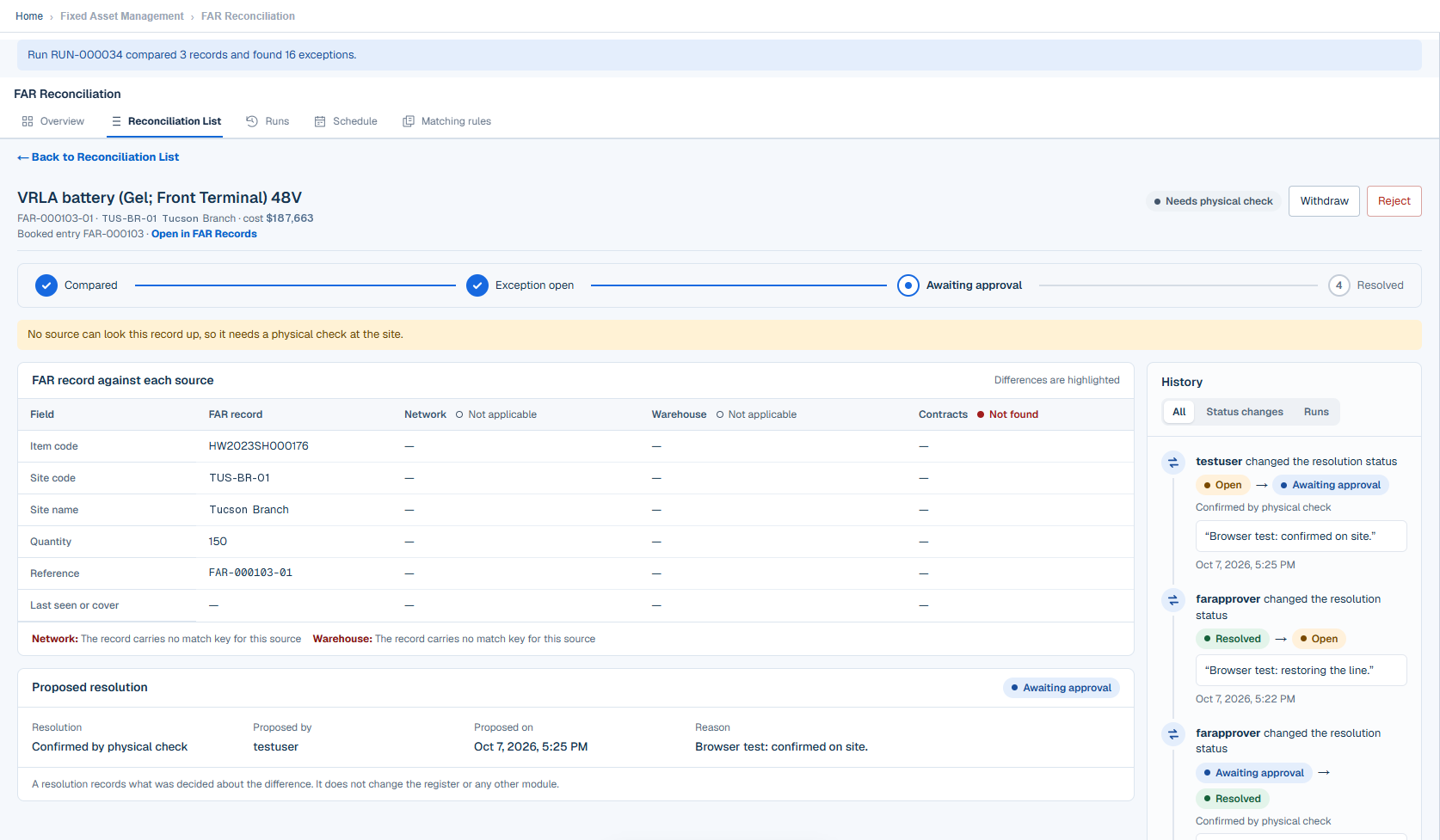
Two people, one decision, all on one screen.
A resolution is proposed by one person and waits for another to approve it. The record shows the stage it has reached, what was proposed and by whom, and the full history beside it.
- Progress from compared to resolved
- Who proposed, when and why
- Every status change listed with its reason
- Withdraw and reject available to the right roles
The same controls, module by module.
Where each control applies across the product.
| Area | Approval | Second-person check | History | Import log |
|---|---|---|---|---|
| Fixed Asset Register | ✓Yes | ✓Yes | ✓Yes | ✓Yes |
| Reconciliation | ✓Yes | ✓Yes | ✓Yes | No |
| CWIP Assets | ✓Yes | No | ✓Yes | ✓Yes |
| Capitalized Assets | ✓Yes | No | ✓Yes | ✓Yes |
| Purchase requests and orders | ✓Yes | No | ✓Yes | ✓Yes |
| Warehouse locations and bins | ✓Yes | No | ✓Yes | ✓Yes |
| Asset lifecycle requests | ✓Yes | No | ✓Yes | No |
| Asset Tagging | ✓Yes | No | ✓Yes | No |
| Asset Discovery | No | No | ✓Yes | No |
Approval means a user with the approver role must decide. Second-person check means the approver cannot be the person who submitted.
Scanning the network without spreading credentials.
Secrets stay in your vault
A discovery job holds only a reference. The secret is fetched from your vault when the scan runs.
Results checked on arrival
Scan results are verified for integrity before they are accepted. Files that fail are set aside, not loaded.
Every run on record
Each run keeps its outcome and issues, such as credential failures and unreachable devices.
You set the policy. The product enforces it.
You decide
- Who your users are, through your identity provider
- Which role each person holds
- Who approves, and at what amount
- Your tag formats, rules and tolerances
assetziq enforces
- Sign-on before any access
- Only the actions a role allows
- Approval before a change takes effect
- History written with every change
Rules the system enforces, so people do not have to remember them.
No silent overwrites
If two people edit the same record, the second is told it has changed instead of overwriting the first.
Validated imports
Imports use templates with size limits, report errors row by row and are kept in an import history.
Business rules enforced
Detailed cost cannot exceed booked value, and work with spend against it cannot be cancelled.
Controlled deletion
Records can be deleted only before they are in use. After that they are closed, not removed.
The records and controls your framework expects.
Standards for asset management, financial reporting and information security ask for the same things: controlled access, authorized change and a reliable record.
- Controlled access through roles and single sign-on
- Authorized change through approvals and maker-checker
- A reliable record through history and reconciliation
- Certification remains with your organization and its auditors; assetziq supplies the evidence
Security and compliance questions, answered.
Can we use our own identity provider?
Yes. assetziq supports single sign-on with enterprise identity providers. The connection is configured during onboarding.
Can one person both submit and approve?
Not in the fixed asset register, where the approver must differ from the submitter. Other modules require a user with the approver role.
Is there a record of who changed what?
Yes. Status history and audit history are written with each business change, and are shown on the record.
What happens when an approval is rejected?
The record returns to the person who submitted it, with the reason. It can be reworked and submitted again, and the rejection stays in the history.
How are discovery credentials protected?
A discovery job stores only a reference. The secret is read from your vault at the moment the scan runs.
Are imports controlled?
Yes. Imports use fixed templates with size limits, errors are reported row by row, and each import is kept in an import history.
Can a record be deleted to hide a change?
No. Records can be deleted only before they are in use. After that they are closed or cancelled, and the history remains.
How does assetziq help with a fixed asset audit?
It keeps the register detailed and approved, reconciles it against operational data, and traces each asset back to its purchase. Auditors can be shown the outcome and the history for any record.
Does assetziq make us compliant with a specific standard?
No software can do that alone. assetziq provides the access controls, approvals and records that such standards expect, and your own processes and auditors determine compliance.
Bring your audit and security teams.
We will walk through access, approvals, reconciliation and audit history in a dedicated briefing.